What Makes a Production Studio a Production Studio?
What actually defines a production studio
A production studio is a space engineered around the needs of a camera crew, which is a different thing from a space that happens to be empty. The distinction is infrastructure. A warehouse with high ceilings can host a shoot, but the crew will spend the first hours of the day building what a real stage already has: a clean background, a lighting position overhead, enough power to run it, and somewhere for the client to sit.
The practical test is simple. Ask what the production has to bring in order to shoot. On a purpose-built stage the answer is the camera package and the talent. In a raw room the answer includes backdrops, stands, distribution, and a plan for where everyone eats.
The cyc wall, and why it comes first
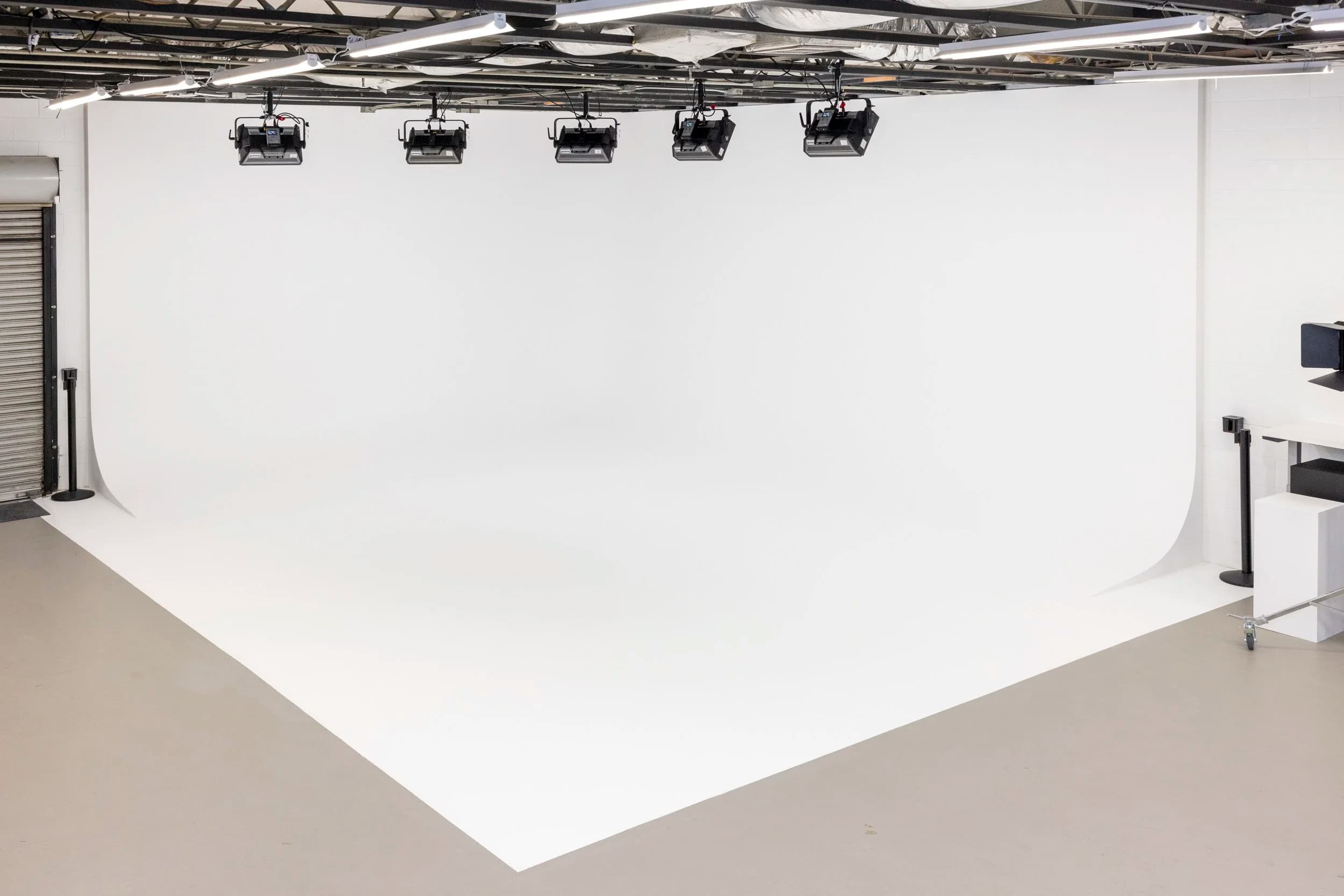
A cyc wall is the single most defining feature of a production studio. Short for cyclorama, it is a wall built with a smooth radius where it meets the floor, so the camera sees no seam, corner, or horizon line. Lit evenly, it reads as an infinite background.
It matters because it replaces an entire category of rental gear and setup time. Seamless paper wrinkles, tears, and needs re-rolling between setups. A cyc takes foot traffic, holds up under weight, and lights consistently across a wide frame. A corner cyc, which wraps the radius across two adjoining walls, widens the arc the camera can travel without catching an edge, which matters most for motion work where the camera rarely sits still.
Grid, power, and lighting position
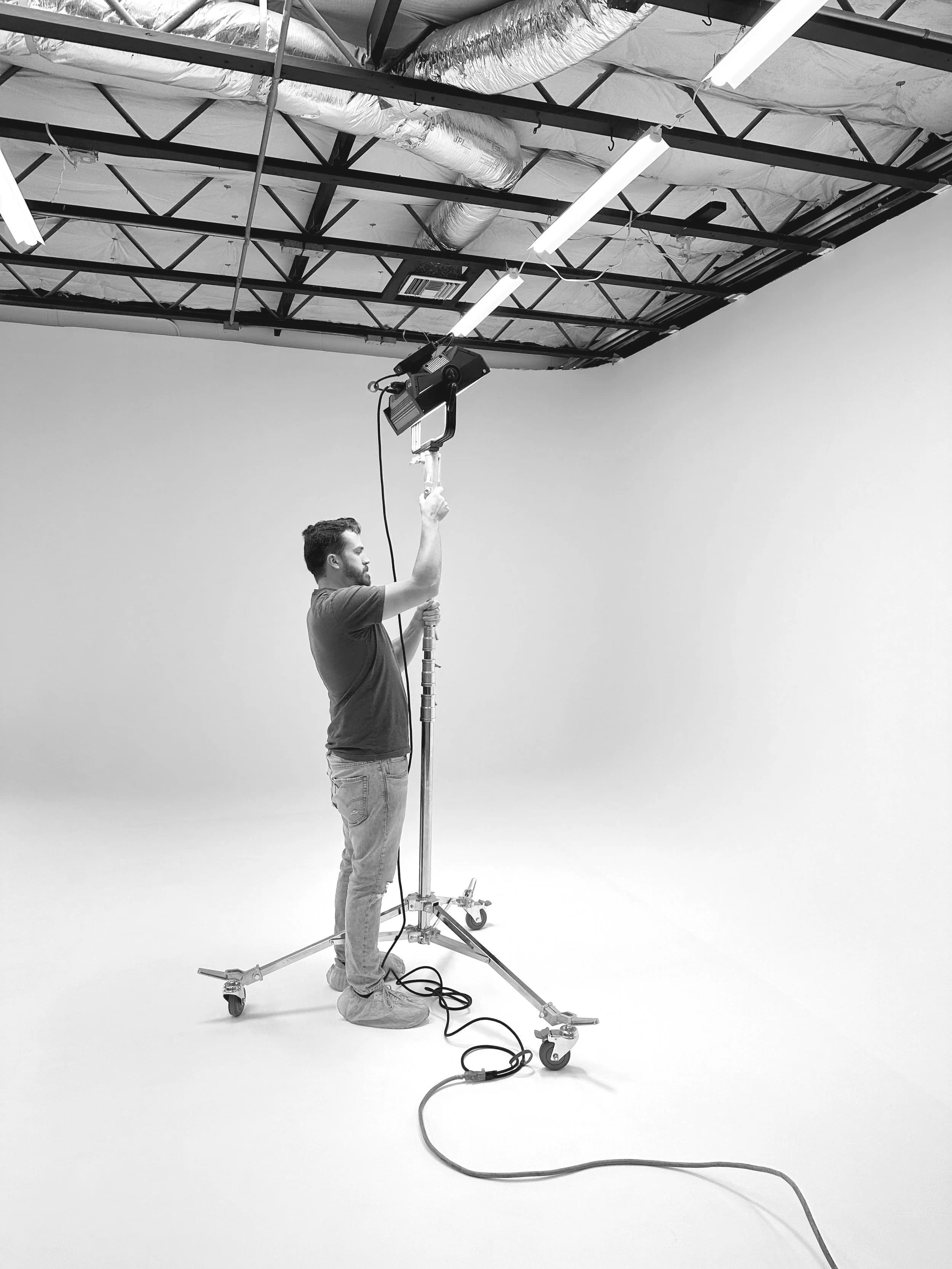
Overhead rigging is what lets a crew put light where the shot needs it instead of where a stand will fit. A studio grid gives you mounting points across the ceiling, which frees floor space and keeps stands out of wide frames. Paired with that, the space needs enough electrical capacity to run a full lighting package without tripping circuits, plus distribution so power reaches the set rather than the wall.
Pre-lit capability is the upgrade most producers underestimate. Lighting a cyc evenly is a craft of its own and it is typically the first hour of a cyc shoot day. A stage that can hand you the wall already washed and balanced returns that hour to the shot list.
Load-in, access, and parking
Load-in decides how much of your day is spent shooting. The details that matter are unglamorous and they compound:
- Ground-level access. A roll-up door opening onto the floor means carts roll straight in. Stairs or a freight elevator can turn a 20 minute load-in into an hour.
- No dock scheduling. Shared docks with time windows add coordination the production has to manage.
- Parking on site. Crew vehicles and gear vans need somewhere legal to sit for ten hours.
- Path from door to set. Narrow hallways and tight corners limit what size flats and set pieces can physically reach the stage.
Amenities are production infrastructure
Amenities read as a nice-to-have on a spec sheet and behave like infrastructure on a ten hour day. A kitchen supports craft services without a catering run. A lobby gives clients somewhere to be that is not standing behind the monitor. Private bathrooms keep the crew from leaving the building. Reliable Wi-Fi lets a producer send selects before wrap.
None of this shows up in the footage, and all of it shows up in how the day runs. A crew that stayed fed and warm shoots better in hour nine than one that did not.
Ceiling height, floor, and sound
Ceiling height is the constraint producers discover too late. You need enough room to place a light above the tallest thing in frame, on a stand, with the modifier attached. A room that measures well on the floor plan but tops out low forces lighting from the sides, which flattens faces and makes wide shots hard to keep clean. Height also decides how tall a set can build and whether a boom can stay out of frame.
The floor matters more than people expect. A studio floor should be level, sealed, and able to take weight, because product shoots roll heavy carts across it and vehicle work needs a surface that will not mark. On a stage with a cyc, the floor is part of the background, so its condition is visible in every wide frame.
Sound is the quiet dealbreaker. A space with hard parallel walls, an exposed metal roof, or an HVAC system you cannot switch off will fight every line of dialogue. Ask whether the air handling can be killed during takes and listen to the room before you commit. Reverb can be treated with blankets and flats, but a noisy mechanical system on a fixed cycle cannot.
The people who run the room
Staffing is the part of a production studio that never appears on a spec sheet and shows up on every shoot day. A studio run by people who know the room can tell you which circuit to avoid, where the light falls at three in the afternoon, and how to rig the thing you did not plan for. A space handed over with a key and a phone number cannot.
This is also what separates a stage from a venue rental. Venues protect the building. Production studios support the shoot. When something goes wrong at hour seven, and something usually does, the difference between those two postures is what decides whether you make your day.
Studio or rented room: a working checklist
Run any candidate space against this list. A production studio answers yes to most of it:
- Seamless cyc wall, ideally a corner cyc
- Overhead lighting grid with real electrical capacity
- Ground-level load-in without stairs or an elevator
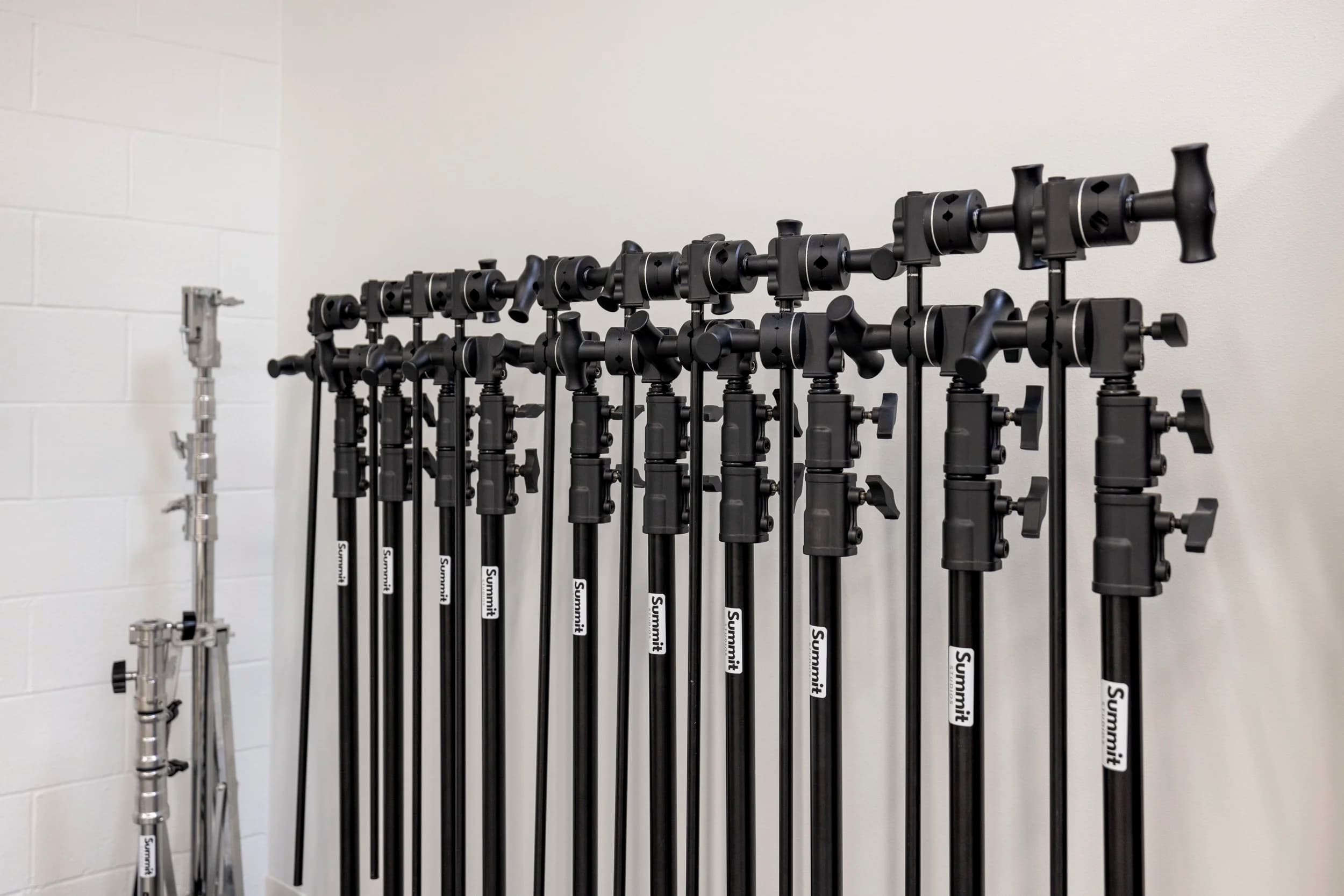
- Camera, lighting, and grip available in the building
- Kitchen, client area, and private bathrooms
- Off-street or on-site parking
- Ceiling height that clears your tallest light on a stand
- Staff who know the room and can solve problems during the shoot
The Summit Studios stage in Santa Barbara is built to that standard, which makes it a useful benchmark whether or not you shoot here.
Frequently asked questions
What is the difference between a production studio and a photo studio?
The terms overlap heavily and most professional stages serve both. A photo studio may be optimized for stills with strobes and tighter setups, while a production studio typically adds the grid, power, and floor space that motion work and larger crews require.
Does a production studio need a cyc wall?
Not strictly, but it is the feature that most defines one. A cyc gives a seamless background no backdrop can match and saves the production the cost and time of renting and rigging one.
How much ceiling height does a production studio need?
Enough to place a light above the tallest element in frame with room to spare. Low ceilings restrict lighting angles, limit how tall a set can build, and make a space feel smaller than its square footage suggests.
Do production studios include equipment?
Usually the stage and equipment are quoted separately. Studios that keep camera, lighting, and grip inventory on site let a production build one package in one place instead of adding a rental house stop.
Can one space handle both photo and video in the same day?
Yes, on a stage set up for it. A pre-lit cyc plus on-site grip and lighting lets a crew swing between stills and motion without a full re-rig, which often saves a production an entire day.